


Upper Egypt, Luxor and Aswan
Cairo, Luxor, Aswan and Abu Simbel
This trip, focusing on Luxor and Aswan in the south, November 2026, takes us back almost 5,000 years. The pharaonic dynasties spanned 3 millennia. No other civilization has proven to be as robust and is one of the reasons for our eternal fascination with ancient Egypt.
We know that many who may be interested in this trip already have a great deal of knowledge about the pharaohs’ doings and deeds. We must therefore assume that you prefer guides who have expert knowledge.
We have focused on having the best intermediaries on our trips, and this is fulfilled by our two guides, whom we will present to you below.
Our offered trip to Upper Egypt in the south is a direct extension of our trip to Alexandria in Lower Egypt in the north. The direction of the Nile determines what is up and down.
You can read about the Alexandria trip here, which you can also sign up for if you want to enjoy all of Egypt’s geography and history at once. We offer a total of DKK 2,000 discount if you choose both trips.
Travel plan
Get an overview of what you will experience on your trip.
Day-to-day overview
Unlike a physical product, a trip is only complete when the trip is over.
Changes will therefore occur and this is also desirable. From the time our trips are offered on the website to the trip itself, it usually takes 6 – 9 months. It would be quite unusual if an offer did not appear during that period that would be a clear improvement to the overall travel experience. However, significant changes to the overview below will not occur.
All our trips are based on our guests wanting to join us on new adventures. This is your guarantee that we will strive, to the best of our ability, to ensure that you get a once in a lifetime experience – every time.
Our days in Cairo, November 1 - 3, 2026
Our Days in Luxor, November 4 - 8, 2026
Wednesday, November 4th, we fly early in the morning to Luxor with Egypt Air. In the afternoon we visit Luxor Temple and Karnak Temple, followed by a visit to the Winter Palace and dinner nearby.
Thursday, November 5th, we go to the West Bank and visit the Valley of the Kings.
Friday, November 6th, the Valley of the Queens and our own temple for an evening. Followed by a surprise.
Saturday, November 7th – day on our own. Evening, dinner together.
Sunday, November 8th: we drive by bus from Luxor to Aswan, stopping at one or two temples along the way.
Our days in Aswan, November 9 - 12, 2026
Monday, November 9th, the Aswan Dam and Philae Temple, as well as a visit and dinner on a Nubian island.
Tuesday, November 10th, we sail on the Fellukka and visit a number of charming islands. We dock at the Old Cataract Hotel. Dinner follows.
Wednesday, November 11th. We go to the Abu Simbel temples.
Thursday, November 12th. Return trip from Aswan to Copenhagen.
Incl. / Excl.:
What is included
- Fire nætter på det 5* Hotel the Ned.
- Kanapéer og velkomstdrinks fredag aften.
- Pub lunch lørdag.
- Operabillet lørdag aften.
- Sunday Roast.
- Signaturmiddag søndag aften.
- Pub lunch mandag.
- Kanapéer og vin i Sigmund Freuds House.
- Kanapéer og drinks til William Hansons event.
- Entré til Highgate Hill, bådfart, alle guidede ture er inkluderet.
- Morgenmad: du kan tilkøbe 4 kuponer á £ 15, der giver dig 4 * £ 26 at spendere i The Ned’s syv restauranter.
- Drikkevarer på restauranter og pubber overlader vi trygt til dig og tjeneren.
Always included
Not included
PRICE
18000 DKK
Deposit
2500 DKK
Location
Hotel Flamenco
02 El Gezira El Wosta, Zamalek, Cairo
Organizer
Parnassos.dk, Overgaden oven Vandet 58A, 2. 1415 Copenhagen
Phone
45 52736316
overtoner@parnassos.dk


Parnassos.dk ApS is a member of the Travel Guarantee Fund. It guarantees your money, while we guarantee your experiences.

Travel information
- Professor Jakob Skovgaard-Petersen
- Professor Arto Belekdanien
- Grand Egyptian Museum
- Cheop’s pyramid
- Islamic Cairo
- On our way to Luxor
- East Bank – Luxor
- West Bank – Luxor
- Our Own Temple for a Night
- The Winter Palace
- We won’t Say Where
- Aswan
- Philae Temple
- Felukka to Aswan Islands
- Dinner at Hotel Old Cataract
- Abu Simbel – and a Nubian Dinner
- What do You Get for Your DKK 18,000?
- Pampering+
Professor Jakob Skovgaard-Petersen
We are proud to be able to announce that the leading Danish Islam expert, Professor Jacob Skovgaard-Petersen of Copenhagen University, will join us throughout the week in Cairo. He will give us a solid background of one of the world’s largest cultures. His lectures will be in English of course.
As you are reading this in English, it’s a reasonable assumption that you are not from Denmark. So, to give some background: Skovgaard-Petersen was embroiled in controversy in the 2000s, when he was attacked by the right-wing press over his attitude towards the Muhammad cartoon crisis and his opinions on immigration.
Sad and shameful. Unless you see it from a marketing point of view; then it doesn’t get much better than that.
We will be treated to his many stories about the city, including when, during the 1980s, he lived in Old Cairo, the most exotic part of the city, where he picked up yellow fever, one of the most exotic diseases. (No longer a risk in Egypt.)
Concerning our specific tour, Jakob says,
Cairo is not only one of the oldest cities in the world, it has for centuries also been one of the largest, as it is today. The many historical eras are still visible in the city, not only beneath the surface but in the many distinctive districts. This is one of the reasons why a walk through Cairo feels like entering a time machine.
Our journey in November is such a tour through its many layers. From the Pharaonic to the Hellenistic, Christian and Jewish in the Fustat quarter. Onwards to the Arab conquest and the Fatimid Caliphate’s new town, al-Qahira, continuing to the heyday of the Mamelukes (1250-1517).
Professor and leading Islam expert Jakob Skovgaard-Petersen. Our guide in Cairo november 2026
Professor and Egyptologist Arto Belekdanien
As mentioned, Jakob Skovgaard-Petersen is our main guide in Alexandria, where our other guide, Arto Belekdanien, is with us for a couple of days. Here he will take care of the Greco-Roman period, or late-Pharaonic era in the city.
On this trip to Luxor and Aswan, we will be swapping places. Now Arto Belekdanien will be our main guide. He is of Egyptian-Armenian origin and educated at Oxford University. His English is clear and well-formed.
Arto is often used by the Danish embassy in Cairo. He was Her Majesty, Queen Mary of Denmark and Foreign Minister Lars Løkke Rasmussen’s personal guide when they were in Cairo for the inauguration of The Grand Egyptian Museum on November 1st, 2025.
Grand Egyptian Museum
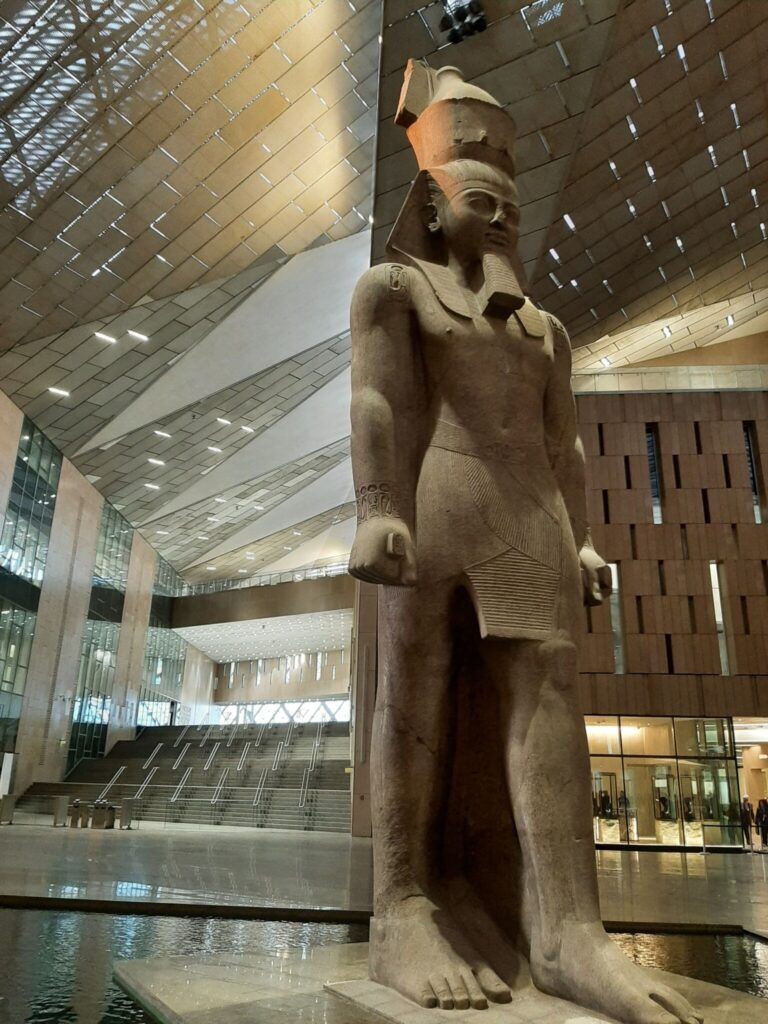
It is obvious to have Arto with us when we visit The Grand Egyptian Museum in Cairo, a short distance from the three Giza pyramids. A museum that has been two decades in the making and has blown all budgets. But now the museum stands here, to the delight of the whole world.
From the moment you step into the vestibule, it is difficult not to be impressed. The museum opened in stages, the last and certainly the most anticipated, as mentioned, took place on November 1st 2025.
The main attraction of the museum, without question, is all of Tutankhamun’s treasures, with several objects that have never been seen by the public before. It is unique. Quite simply.
Arto brings these treasures back to life. When we are at the end of our guided tour, a formidable view of the Giza pyramid plateau awaits us.
The Pyramid Plateau
The photo shows the Giza plateau with its three pyramids. You never get tired of this view. The pyramid of Cheop’s is furthest away and Menkaure closest. Then there are the pyramids of Menkaure’s three wives.
We continue the trip from GEM to these three pyramids and the five millennia. This will be our fifth group trip to Cairo. And every time we have guests with us, who have dreamt of standing in front of these man-made mastodons all their lives.
For them it is an almost spiritual moment. During our last trip, Arto told us that when Tut-Ank-Amon lived, Cheop’s pyramid had already stood there for 1200 years.
This plateau has also been given a facelift. There is a new entrance to the pyramids, which is much more elegant and you get rid of – almost – the many hustlers who used to walk around and devalue the experience.
Old Cairo, Islamic Cairo, Downtown Cairo
We have had about 120 guests in total to Cairo. Many of these have shown interest in joining us on an extended tour that includes Alexandria as well as this trip to Luxor and Aswan.
We will therefore make an effort not to make an exact copy of what we have shown of Cairo so far. That is easy because the city will not run out of exceptional experiences for many months – actually years.
The route we will take during “Jacob’s Day” on November 2nd in Cairo is not yet fully determined, but we will start at Bab al-Nasr, one of the remaining three city gates in Cairo, built in the year 1087. We will continue to Bab al-Futuh, city gate no. 2.
Onwards to the Khan al-Khalili district with its countless small bazaar streets. By bus we can reach Fustat, the Christian district of Cairo, with a large church complex, including the “hanging church” in the immediate vicinity.
If time permits, we will visit the Ibn Tulun, al-Takkiya al-Mawlawiya, Sharia al-Suyufiyya, Sultan Hassan and Al-Rifai mosques.
From here, on to the City of the Dead, whose residents share their houses with the living.
First Stop Luxor
With Cairo and the pyramids behind us, we take the domestic flight to Luxor on Wednesday morning, November 4th, just an hour from Cairo airport.
Luxor is divided into two, the east and west banks, with the Nile as the separator. The east bank is the city’s administrative center and has been so for thousands of years. On the east bank we also find Luxor Temple, which will be our first pharaonic stop.
I will let Arto take over: “The temple, with this simple name, as it is known today, shows us the intricate theology that is at the heart of Pharaonic culture.
Here were the mystical rituals that took place during the extremely important annual Opet Festival, on the outcome of which the fate of the entire created world depended.
The battle reliefs of Ramses II on the monumental gate show us the incredibly vivid scenes of the religious procession during the festival. As we move through this temple, I will tell you all about the unusually complex symbolism that is a recurring theme.”
East Bank - The Karnak Temple
After the visit, you have two options: (of course, you can decide to skip any event at any time). You can either take our bus to the Karnak Temple, or choose to walk along the 2 miles long Alley of Sphinxes and Processional Way that connects the two temple complexes, flanked by sphinxes.
Arto takes over again,
“Karnak’s primary fame is the great temple of Amun. Enormous wealth flowed into Egypt thanks to the successful reigns of the Amun pharaohs. A fact that is reflected in the size, opulence and beauty of Karnak’s monuments.
Unlike many other places, what you see in Karnak is not the result of one or even a few kings. It is the result of over two thousand years of royal projects and expansions! We are overwhelmed by its tall obelisks, towering pylons, tall columns, colossal statues and sublime art.”
Colossi of Memnon on the west bank of Luxor
The West Bank - Luxor
The largest concentration of the ancient Egyptian kingdoms in all of Egypt can be found at Luxor’s West Bank. Thousands of years of construction gathered within a few dozen square kilometers.
We have set aside two days to enjoy the Valley of the Kings, the Valley of the Queens and the tombs of the nobility.
Arto continues.
“On the West Bank of the Nile, the kings build temples where their funerary cults would be performed and through which they could live on in the afterlife.
Continuing the theme of prosperity, creativity and greatness, the mortuary temple of the female pharaoh, Hatshepsut, is a feast for the eyes. Man-made terraces gradually rise up the steep cliff face with graceful colonnades and blend organically with the natural landscape.
The walls of the temple are adorned with beautiful reliefs. One series shows the trading expedition that Hatshepsut sent to the mysterious land of Punt, whose location is still uncertain. In another sequence, Hatshepsut tells the story of her miraculous conception and announces to all that her rule was divinely ordained.”
A Temple for an Evening
We continue our journey through time. We will see and hear about Tut-Ank-Amon’s tomb, we will go on to the Valley of the Kings and finally, with the kind permission of the Egyptian Ministry of Antiquity, we have been granted unique access to the Medinet Habu temple, which we will have to ourselves in the evening.
In Arto’s words, “Medinet Habu, on the west bank of the Nile, is the site of several monuments, the most prominent of which is the mortuary temple of one of ancient Egypt’s most accomplished rulers: Ramesses III. Prepare to be amazed. This is the best-preserved temple from before the Greco-Roman period, and the colors that have been preserved will leave you speechless.
Here you will see its monumental gateway, large open courtyards surrounded by royal statues, stunning reliefs depicting temple rituals and religious festivals, but also warfare.
This temple was built during the final flourishing of the incredibly successful New Kingdom, at a time when not only Egypt, but the entire Near East and the Mediterranean were undergoing a relatively sudden and catastrophic sequence of events that scholars today call the “Bronze Age Collapse.”
In the middle of nowhere near Luxor we find the entrance to the Garden of Paradise. This is where we will be Friday evening, November 6, 2026.
We Won't Say Where
Under the description of the trip to Alexandria, you can read a section about the this writer’s brother, Bent, whom we had to say goodbye to three years ago.
He lived in Egypt for three decades, and I have since taken over his apartment in Cairo and inherited his circle of friends, which has been of invaluable importance in creating this type of unique trip.
One of these is Claes Raben, a native of Funen in Denmark, who also lives in Cairo. He and I are in constant communication and he helps point out the places needed to lift the trip, as will happen on this evening.
In the evening, after we have said goodbye to the Medinet Habu temple, we drive to, and end our stay, in Luxor at the most idyllic place in Luxor. We won’t say where. We won’t say more for now.
The Winter Palace
The British had de facto control over Egypt in the years 1882 – 1952, when the Khedives as a marionette government. You can read our article here about the rather fascinating Khedive Opera House in Cairo.
The British needed to have control over the Suez Canal in order to secure traffic to the Indian subcontinent. Egypt thus became a stopover for travelers between England and India and it was at the same time a popular travel destination for the aristocracy. To meet their needs, The Winter Palace in Luxor was built and inaugurated in 1886.
We find it obvious that either Wednesday the 4th or Thursday the 5th of November we move into another time period, the British colonial era at The Winter Palace. In connection with the hotel there is a shop that sells copies of old photos from these colonial days, very reasonable priced of around £ 10/picture. These are obvious souvenirs.
It was at The Winter Palace that archaeologist Howard Carter announced to the international press in 1921 that he had found an intact tomb, one of a certain Tut-Ank-Amon.
We will enjoy a sundowner in the garden before moving on to our restaurant within walking distance.
From Luxor to Aswan
On Saturday, November 7, 2026, we will take a bus along the Nile on the 150 miles long trip to Aswan. There are three important temples along the way, Esna, Edfu and Kom Ombo. We choose to visit one, and we will let Arto decide which one.
Our focus is on the city of Aswan and its surroundings. In a way, Luxor and Aswan resemble each other; geographically at least; but the atmosphere of the latter is significantly more relaxed.
Luxor can be a bit of a test for the individual traveler, with the rather insistent vendors. In Aswan, it is different, and that alone makes it a pleasure to wander around the city and its bazaars.
After we have been registered at our hotel, we take a quick trip to the elegant bazaar street nearby, where we have found a wonderful little spice shop, with Nubian flavors, among other things. We have had them mix a small package for each of us.
Overlooking the Philae temple
When we are in Aswan we are also in Nubian territory, an ancient people and culture. In the Bible, Nubia is called Kush, mentioned over 50 times in the Old Testament. Moses’ wife was supposedly Nubian.
The Nubian kingdom stretched from the 1st cataract near Aswan to the 6th cataract near the Sudanese capital, Khartoum. Today it is impossible to travel to Sudan due to a particularly bloody civil war. But when peace comes, it is obvious to go to the Nubian pyramids in Northern Sudan. More about this hopefully in a few years.
Between the 1st Aswan Dam (built by the British in 1902) and the second dam, built with the help from the Soviet Union, there are a number of islands, including the island of Bigeh, which is owned by a Nubian family. They have promised to show us around the island, with a few smaller temple ruins.
In the evening, they serve us dinner, where we have a perfect view of the extremely beautiful Philae temple, which we will of course also visit.
The same morning, we go to the great Aswan Dam overlooking Lake Nasser, where we also see the 75-meter-high Soviet monument, shaped like a lotus, as a memory of the two countries’ bromance in the 1960s and 70s.
Island hopping with a Fellukka
The next morning, Monday November 9th, we visit the unfinished obelisk and nearby we have found the spookiest place ever. If Stephen King had known about the area, it would immediately inspired him to write a novel. We will experience the thrill together.
Next, it is time to enjoy a half-day trip on the Nile in the emblematic sailing boats, the felukkas.
The moment we set sail, you will immediately get a calmer pulse, at a pace in contrast to the hustle and bustle of the city and in harmony with the flow of the Nile.
We first sail towards the tombs of the nobility, close to the Nubian eco-village, where we also stop by. On to the lush botanical garden on Kitchener Island, the name taken from Lord Kitchener, who in 1899 had the idea to use the island as his own botanical garden.
There are several islands here and we go ashore among some of them, all rich in monuments. We finish at Seheig Island with the famous famine stele before sailing to….
Dinner at the Old Cataract
Aswan’s counterpart to Luxor’s Winter Palace is The Old Cataract, both are now 5* luxury hotels, but the latter is at a price range of its own. We have been allowed to dock our Fellukka at the hotel’s pier, because this is where we will enjoy dinner tonight.
Yes, it is pure luxury, but it is first and foremost history. The hotel was inaugurated in 1899 and in 1902 the young Winston Churchill stayed here in connection with the opening of the first Aswan Dam. Churchill must have liked the place because he was also here during periods of World War II.
Agatha Christie wrote her novel, Death on the Nile, here in 1937, with a view of her subject from her room number 1201.
The hotel provides a guide for us, who will show us around. If The Churchill Suite is not rented out, we will have a look inside. The same applies to the Agatha Christie suite.
Abu Simbel
We are now at our last full day together. Admittedly, our trips are pretty compact. It may therefore be that some of our guests just want to experience the city on their own. You can decide on this right up until the evening before.
The day consists of a long drive through the desert to, it must be mentioned, one of the highlights of the trip: the trip to the temple in Abu Simbel, Egypt’s southernmost city and just 20 kilometers from the Sudanese border.
Abu Simbel is famous for two reasons. First, the temples themselves, built by one of the most powerful pharaohs, Ramses II, with the facade of the largest temple consisting of four colossal statues, dedicated to the gods Amun, Ro-Horakhty and Ptah as well as Ramses II himself. No false modesty here.
The temples were lifted – stone by stone – to this higher level in the 1960s to avoid them being submerged after the completion of the Great Aswan Dam. An enormous engineering feat. The temples are a UNESCO World Heritage Site.
Back in Aswan we have our dinner. The next day, Thursday 12th November 2026, early in the morning, we fly from Aswan back to Cairo – and for those who have booked the flight, immediately on to Copenhagen.
What do You Get for Your DKK 18,000?
What is included:
Hotel, 11 nights with breakfast at 4* hotels in Cairo, Luxor and Aswan.
All transport – including domestic flights Cairo/Luxor and Aswan.
All local guides, access to the Giza pyramids*, all museum and temple entrances including GEM are included. Drinks for our own events.
(* However, not if you want to enter the Cheops pyramid yourself, tickets for this must be purchased separately).
11 * dinners/buffets. That is, all dinners during our trip.
Free bar in the evening.
xxxxxxxxxxxxxx
What is not included:
Flight Copenhagen – Cairo. We have booked direct flights from Copenhagen with Egypt Air, which can be purchased. Price DKK 4,600/person.
Lunches. We always find restaurants with extremely reasonable prices for this part of the trip.
Wine/beer for our dinners.
Visa, currently $25, around 200 DKK, which is issued at Cairo airport.
In addition, we would like to ask for €40 for bakshish or tips, as this is an expense we cannot deduct from our accounts.
Tempted? You can book the trip via this link.
A Bit of Luxury
All our trips are built around a common program, as above. In addition, we offer flexibility to meet our guests’ wishes as much as possible. This applies, for example, to the flight itself, the trip between Copenhagen and Cairo.
Here is what we also offer:
Cairo – Luxor – Aswan from November 1st – 12th is an extension of the trip, Alexandria-Cairo, October 24th – November 1st.
You are welcome to sign up for both trips, as they complement each other well. We give a DKK 2,000 discount for a combined bookings.
You can also choose extra days for the trip. Perhaps you want to join the first team for a day or two? Likewise, you may also want to continue the trip after November 12th.
Do you want to upgrade your stay to the Marriott, Winter Palace and/or Old Cataract hotels while we are in Cairo, Luxor and Aswan respectively, then let us know.
We can also book Sir Winston Churchill’s suite at Old Cataract for DKKK 72,000 kroner/night, if there is any interest. 