


Cairo – November 2025
Mono- og Polytheism in Cairo
Egypt’s capital, Cairo, is the unofficial center of Islamic culture. At the same time, the city is also the heir to what remains of the Seven Wonders of the Ancient World, the unfathomable Cheops Pyramid.
A city of many layers. It can be your home between November 1st – 8th, 2025.
If the following interests you, or you have any questions, please feel free to call us on +45 5273 6316. We are open every weekday from 9:00 AM – 6:00 PM. Saturdays and Sundays from 10:00 AM – 4:00 PM. Or write to us at overtoner@parnassos.dk.
Travel plan
Get an overview of what you will experience on your trip.
Day-to-day overview
Unlike a physical product, a trip is only complete when the trip is over.
Changes will therefore occur and this is also desirable. From the time our trips are offered on the website to the trip itself, it usually takes 6 – 9 months. It would be quite unusual if an offer did not appear during that period that would be a clear improvement to the overall travel experience. However, significant changes to the overview below will not occur.
All our trips are based on our guests wanting to join us on new adventures. This is your guarantee that we will strive, to the best of our ability, to ensure that you get a once in a lifetime experience – every time.
First weekend, a Coptic church and speedboats on the Nile
We arrive at our hotel late Saturday evening. A light supper awaits us. Sunday morning we head to Maadi, south of Cairo.
We visit the city’s Coptic church, have lunch on their church ship, sail on the Fellukka, have tea and cakes at The Yacht Club. A speedboat takes us back to the hotel. After a rest, our bus takes us to the restaurant for the evening.
Days 3 and 5: Professor Jakob Skovgaard-Petersen's days
Islam expert and professor Jakob Skovgaard-Petersen takes us to Old Cairo on Monday, continuing to the Beyt Yakan Institute. Monday evening ends at the Makan Theater, which serves us a buffet.
On Wednesday, our journey continues to the Ben Ezra Synagogue, the Hanging Church. After lunch, we go to the NMEC Museum, or National Museum of Egyptian Civilization. Here, Yasmine el Dorghamy from the American University will give us a lecture.
Jakob then takes us to the City of the Dead. In the evening, we have our dinner at the iconic The Royal Automobile Club
Days 4 and 6: Professor Arto Belekdanien's days
Day 7: a garbage town and a ghost town
Our most surreal day. We drive through The Garbage City and to the incomparable rock church, the Tanner St. Simon’s Church.
After lunch we head to The New Administrative Capital with space for 5 million inhabitants, none of whom have yet moved in. We end our last evening with a surprise.
Incl. / Excl.:
What is included
- Fire nætter på det 5* Hotel the Ned.
- Kanapéer og velkomstdrinks fredag aften.
- Pub lunch lørdag.
- Operabillet lørdag aften.
- Sunday Roast.
- Signaturmiddag søndag aften.
- Pub lunch mandag.
- Kanapéer og vin i Sigmund Freuds House.
- Kanapéer og drinks til William Hansons event.
- Entré til Highgate Hill, bådfart, alle guidede ture er inkluderet.
- Morgenmad: du kan tilkøbe 4 kuponer á £ 15, der giver dig 4 * £ 26 at spendere i The Ned’s syv restauranter.
- Drikkevarer på restauranter og pubber overlader vi trygt til dig og tjeneren.
Always included
Not included
PRICE
13000 DKK
Deposit
2500 DKK
Location
Hotel Flamenco
02 El Gezira El Wosta, Zamalek, Cairo
Organizer
Parnassos.dk, Overgaden oven Vandet 58A, 2. 1415 Copenhagen
Phone
45 52736316
overtoner@parnassos.dk


Parnassos.dk ApS is a member of the Travel Guarantee Fund. It guarantees your money, while we guarantee your experiences.
Travel dates:
Mono- and Polytheism in Cairo November 2025
- Start date:
- End date:
- Price:
Mono- and Polytheism in Cairo November 2025
- Start date:
- End date:
- Price:
Travel information
- Professor Jakob Skovgaard-Petersen
- Maadi
- Al Azhar
- Exorcism and healing
- The Egyptologist
- The Desert Pyramids
- Signature dinner at Mena House
- Ben Ezra Synagogue
- Guide Yasmine
- City of the Dead
- The Giza Pyramid Plateau
- The Grand Egyptian Museum
- The Opera House
- Coptic youth
- Capital City
- Nile by Night
- A Secret
- My brother, Bent
- Safety in Cairo
- What do you get for your money?
Professor Jakob Skovgaard-Petersen
We are proud to be able to announce that the leading Danish Islam expert, Professor Jacob Skovgaard-Petersen of Copenhagen University, will join us throughout the week in Cairo. He will give us a solid background of one of the world’s largest cultures. His lectures will be in English of course.
As you are reading this in English, it’s a reasonable assumption that you are not from Denmark. So, to give some background: Skovgaard-Petersen was embroiled in controversy in the 2000s, when he was attacked by the right-wing press over his attitude towards the Muhammad cartoon crisis and his opinions on immigration.
Sad and shameful. Unless you see it from a marketing point of view; then it doesn’t get much better than that.
We will be treated to his many stories about the city, including when, during the 1980s, he lived in Old Cairo, the most exotic part of the city, where he picked up yellow fever, one of the most exotic diseases. (No longer a risk in Egypt.)
Concerning our specific tour, Jakob says,
Cairo is not only one of the oldest cities in the world, it has for centuries also been one of the largest, as it is today. The many historical eras are still visible in the city, not only beneath the surface but in the many distinctive districts. This is one of the reasons why a walk through Cairo feels like entering a time machine.
Our journey in November is such a tour through its many layers. From the Pharaonic to the Hellenistic, Christian and Jewish in the Fustat quarter. Onwards to the Arab conquest and the Fatimid Caliphate’s new town, al-Qahira, continuing to the heyday of the Mamelukes (1250-1517).
Professor and leading Islam expert Jakob Skovgaard-Petersen. Our guide in Cairo november 2023
We will visit the Osmanic town that [Danish/German explorer] Carsten Niebuhr visited and later on Napoleon conquered.
Then we arrive at the elegant fin-de-siècle Cairo with boulevards and parks. From the colonial days’ nationalistic expressions to the independence in 1954 and socialism’s modernism. We will finally arrive at today’s Cairo with slums, chaos, decay, side by side with the nouveau riche quarters.
It takes time to master a city like Cairo. But we will give it a try during our stay.
As mentioned, Jakob will stay with us throughout the week. Not only is he an expert in the Arabic cultures, his command of the Arabic language is at a level where even the Danish expats feel intimidated.
The Church of the Blessed Virgin in Maadi
Maadi - South of Cairo
We arrive late Saturday evening at the hotel. Once everyone has been assigned their rooms, a light supper is served at the hotel restaurant. Included in the price.
On our first day, Sunday, November 2nd, a bus takes us a little south of Cairo, where we will visit what we consider to be the most interesting Coptic church in the capital, the “Church of the Virgin Mary in Maadi”. Here, the church’s priest, Stefanos, will welcome us. The church is interesting because it is more intimate – and it has had distinguished visitors since the dawn of time. Here you will find the early beginnings of Christianity. Literally. According to the Gospel of Matthew, an angel appears to Joseph and says,
“Get up, take the child and his mother and flee to Egypt, and remain there until I tell you. For Herod is going to search for the child to destroy him.” …And he stayed there until Herod died.”
According to tradition, the family hid for a month in Maadi – an area with a large Jewish population at the time – precisely where the church has since been built. Not only that, Stefanos has promised to let us in to the most holy place of the church. The crypt, where tradition says the family hid from Herod’s spies. Hardly any historian “buys” the story, but for an hour we place our skepticism at the church’s cloakroom. Why not?
Stefanos will then talk about what it means to belong to a Christian minority in an Islamic society. Our Sunday afternoon is sacrificed the Nile. We have been allowed to borrow the church’s ship, which is used during the congregation’s social events. We sail onto the Nile while we have our lunch, which is included in the price of the trip.
It docks where The Fellucas take over. We continue the Nile trip on these sailboats. We then dock again at the elegant Maadi Yacht Club, of which Parnassos.dk is a member. Tea, coffee and cakes are served before we return to our hotel. Via speedboat!
Sunday evening we take our bus to a restaurant, where dinner is included in the price. And for those who want, afterwards to a bar nearby our hotel.
Al Azhar, Old Cairo, Khan el-Khalili
Jakob Skovgaard-Petersen is our guide all Monday. We leave the hotel at 9:30 am, where the bus takes us to Bab al-Nasr, one of the remaining three city gates in Cairo, built in the year 1087. A natural place to start our tour of Old Cairo.
We walk down to Bab al-Futuh, city gate no. 2, where our first stop is at the beautiful al-Hakim Mosque.
Next, we visit the house of Bayt al-Soheimi and the Sultan Qalawoun complex, from the 13th century.
We have lunch at the Khan al-Khalili district, with its countless small bazaar streets, followed by a 1 ½ hour break to enjoy the area on your own, or sit in a café and experience the life around you.
In the afternoon we continue to al-Azhar and the al-Ghuriyya Mosque, built during the Mamluk regime. The next stop is Bab Zuweila, the last remaining city gate, to end at Egypt’s Blue Mosque via The Tentmakers’ Street. By the time we get there, Jakob will have given us a good grasp of the entire Islamic political and cultural history.
Late in the afternoon we arrive at the newly restored house, Beit Yakan, where the Danish Institute is based. There will be a lecture by the house’s owner, architect Alaa El-Habashi, and we will be served sandwiches, coffee and tea – included in the price – in their magical courtyard.
Then, when the sun sets, it is time for exorcism in El-Sayeda Zainab.
View of Old Cairo
Nubian ZAR music in Old Cairo
Exorcism and healing in Cairo
In the El-Sayeda Zainab district there is a small theater that specializes in Nubian music, also called ZAR music, the purpose of which is to exorcise demons. I have attended several performances. And it works!
It is an evening that is honestly difficult to describe, but the singers and musicians are strangely charismatic. And here it is the women who take the lead. Half of us have to sit on the floor. That way it is also easier to levitate.
We have rented the entire theater. We bring pillows and blankets, and after the performance the owner of the place, Ahmed el Maghraby, will serve us a dinner, which is included in the price. And here we will also have the opportunity to meet the musicians and singers who, we think, you will fall in love with.
The Egyptologist of The Ministry of Antiquity
While Jakob takes care of the brand new culture, Islam, born in the 7th century, our Egyptologist for the trip, Arto Belekdanian, will take us under his wings for two of the days and take us back to the beginning of civilization. Arto is of Egyptian-Armenian origin. He has a PhD in Oriental Studies in Egyptology and educated at Oxford University.
He is an editor of National Geographic and a BBC’s expert advisor for their program, ‘Unearthed’. I can find 11 scientific publications to his name. On top, he is an extremely pleasant person. If you get stuck in the middle of translating the hieroglyphs, for example, he is ready to help you move on to the next sentence.
Last but not least, Arto works for The Ministry of Antiquity in Cairo, which issues permits to visit mausoleums, temples and the like that are usually closed to the public. It would not be in the spirit of Parnassos.dk not to take full advantage of that opportunity.
Professor and Egyptologist Arto Belekdanian, here at a reception at the Danish Ambassadors’ home.
Sunset over the land of Mordor – image of the bent or broken pyramid
The Desert Pyramids of Dahshur
Tuesday morning, we leave Cairo and head west towards the Pharaonic pyramids. They are close to incomprehensible, especially the three Giza pyramids, which we will visit during our Thursday.
Regarding these particular “Thursday” pyramids: Egyptologists have a certain ambivalence, as they have also almost become clichés. But of naturally, it goes without saying, we just have to visit them.
But for our Tuesday, Arto will take us further south, to a number of excavation sites at the Djoser pyramid on the Saqqara plateau. Our bus will make its first stop there. At the nearby Saqqara Palm Club we will have our lunch, which is included in the price.
Then we will go on to the incomparable pyramids at Dahshur. They are not as magnificent as their siblings at Giza, but there are virtually no tourists here, which gives us the possibility to contemplate the enormity of these mega structures.
Signature dinner at Mena House
What better way to end Tuesday than with a dinner at Mena House, right across the Great Pyramid of Giza? Mena House is a hotel, inaugurated in 1886, whose mythology is linked to the 20th century. It was here that heads of state, kings and queens and celebrities made a pilgrimage when they visited Egypt. Winston Churchill, Agatha Christie and Charlie Chaplin, to name a few.
Here, in December 1977, Egypt and Israel sat down at the table and began their peace negotiations that culminated in the Camp David Accords the following September.
Here we will be seated at our tables at 7:00 p.m. with a view of the first wonder of the world.
Usually the pyramids are shrouded in darkness, but not during our evening. The plateau’s lighting master is ready with his lights. And then humanity’s most enigmatic structure is lit up for an hour. It’s a view to behold.
The magic is not over yet, as we have requested entertainment. Archaic dances await at our tables. Dinner is included in the price.
We enjoy our signature dinner at the luxurious Mena House with the oldest of the Seven Wonders of the World in the background.
Ben Ezra Synagogue in Cairo
Ben Ezra Synagogue in Cairo
Jacob takes over for our Wednesday.
He will take us to old Cairo, Islamic Cairo, to Fustat where we will visit the Ben Ezra Synagogue, one of the most interesting synagogues in the world.
According to tradition, the synagogue is located exactly on the same spot where the infant Moses was found in a reed boat. The building probably dates back to the pre-Islamic period. It has experienced a bit of everything since then. In addition to its unique history, the most interesting thing about the Cairo Synagogue is the Geniza manuscripts.
The Geniza is a storage place for the Jewish holy scriptures, as well as written pages that contain the name of God, YHVH, as these pages were not allowed to be burned or thrown away. And the Ben Ezra Synagogue’s Geniza had accumulated documents to an enormous extent.
Their historical value was only noticed at the end of the 19th century, documents that were up to 850 years old.
We will also have time to look inside the “hanging church” in the immediate vicinity. And then it’s time for lunch, which is included in the price.
Yasmine El Dorghamy as guide
After our lunch in the Fustat district, near the synagogue, the bus takes us to the new large National Museum of Egyptian Civilization (NMEC, pronounced Nemec) where we will find, among other things, the new resting place of the mummified pharaos.
Here, Yasmine El Dorghamy, assistant professor of the American University in Cairo, will take over for a while. She will give a lecture and guide us through the textile gallery, which is her specialty. Textiles of the earliest times of Egypt and to the present day. She is a great communicator. You will get 5000 years of Egyptian history through the clothing of the population.
Her C/V:
Yasmine El Dorghamy is the founder of Rawi Publishing for Egyptian History, Heritage & Art; a bilingual research and publishing platform. Each year, Rawi publishes its namesake flagship periodical, a reference-quality publication in both English and Arabic, on a selected topic from Egyptian history.
Themes of past editions include the History of Modern Egyptian Art, history of the Egyptian cinema industry and of Egyptian cuisine. The most recent publication focused on Egypt’s costume history and traced the changes and trends in Egyptian dress over five millennia. El Dorghamy also teaches Visual Culture at the American University in Cairo (AUC).
Yasmine el Dorghamy, assistant professor at the American University in Cairo.
The City of the Dead, a very fascinating area of Cairo
Cairo Necropolis - City of the Dead
After being dressed up by Yasmine, and with NMEC behind us, Jakob Skovgaard takes over again and leads us to the Ibn Tulun Mosque, the largest and oldest mosque in Cairo, built in the years 876 – 879.
From there, we continue to al-Takkiya al-Mawlawiya in Sharia al-Suyufiyya and the Sultan Hassan and Al-Rifai mosques. Each representing interesting stories and backgrounds. The more you ask about this, the more you find out that Jakob is omniscient within his profession.
Onwards to the City of the Dead, whose residents share houses with the living. It is, shall we say, a pretty distinctive district. Jakob tells us about these significant areas of the city and about the Muslim customs associated with this.
Incidentally, we have listening equipment with us on our tours, so everyone can hear even though we occasionally run into large crowds.
Parnassos.dk is a member of the iconic The Royal Automobile Club in Cairo. We have our dinner, which is included in the price, at the club located in Downtown. A truly unique experience.
The Pyramid Plateau of Giza
Back to Arto again during our Thursday.
The photo shows the Giza plateau with its three pyramids. You never get tired of this view. The pyramid of Cheops furthest away and Menkaure’s closest. Then there are the pyramids of Menkaure’s three wives. Correct. We are still not quite there when it comes to equality between men and women. I still think we have come a long way in the last 4500 years.
In the morning, Arto takes us to all three pyramids and their five millennia.
This will be our fourth group trip to Cairo. And every time we have guests with us who have dreamed of standing in front of these man-made mastodons all their life. For them, it is an almost spiritual moment.
Menkaure in the foreground – and a pyramid each for his three wives
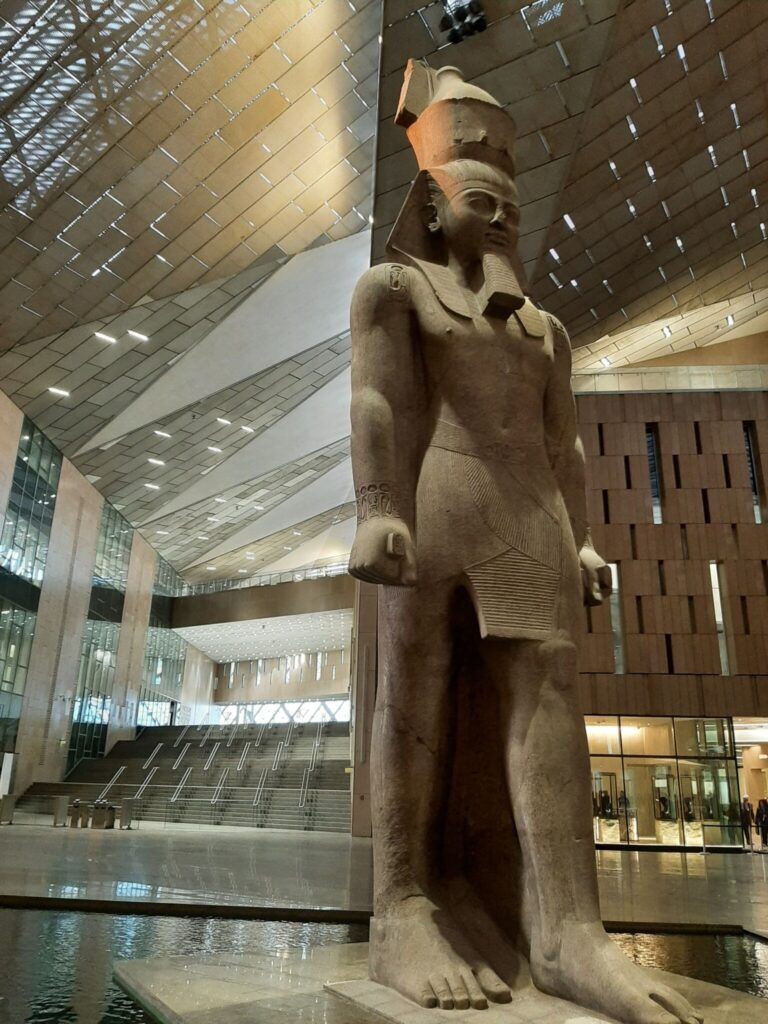
Ramses II, the perfect host for ‘the Grand Egyptian Museum’
Grand Egyptian Museum
The Grand Egyptian Museum, a short distance from the three Giza pyramids, is a museum that has been a decade in the making and has blown all budgets. It is unfortunate, of course, but it has been seen before in the history of mankind.
Inside the lobby, it is hard to not get overwhelmed. Although there is not yet full access to the entire museum, it is easy to predict that it will be the biggest global cultural event of the decade when all parts of the museum are open to the public.
No one knows the exact date of the full inauguration. Even Arto can only guess. The decision is at a ministerial level, and presumably also at the presidential level.
The final stage will be when Tut-Ank Amon’s treasures are transferred from the Egyptian Museum in Cairo. With fanfare, no doubt. The latest news – to be taken with a pinch of salt – is late 2025.
What is available to us now is enough for Arto to give us a tour of the Middle Kingdom. And when we reach the end of our guided tour, a unique view of the Giza plateau awaits us.
There are a number of rather delicious cafes in the museum. Here we will each have our lunch before Arto continues the story. This lunch is between our guests and the waiter.
The Opera House in Cairo
One of our evenings is consecrated a concert at the Opera house in Cairo. The program has not yet been announced but we await it with excitement. It’s going to be fun and pretty different if you are used to the posh opera houses of Europe.
As mentioned, I was stuck in Cairo during the Corona crises. But finally, in July 2020 the opera house, as one of the first cultural institutions in the country opened its doors.
It was an outdoor event. We were listening to Peer Gynt by Edward Grieg. Admittedly, it was not the Vienna philharmonic’s who played, but after several months of lockdown and cultural starvation it is some of the most beautiful music I’ve ever listened to. Only briefly interrupted by a couple of cats, who all of a sudden, decided to continue the lineage. No propriety.
This time we will sit inside the opera house. There is one major difference, however, from the European counterparts. It’s the dress code. True, in Europe It is frowned upon if you turn up sloppily dressed. But in Egypt you are expected to be well dressed. That includes men wearing ties. One is just not allowed entrance without.
Gezira Opera House, Cairo
The entrance to Garbage City near the Mokattam mountains
7000 tons of Daily Garbage to Garbage City
Al Abageyah in Cairo is a candidate to be the most bizarre place on the planet. It is truly unparalleled. You will see it for yourself Friday morning, a day dedicated to surrealism.
Around 140,000 people live there and they make a living by sorting the bulky waste of the city’s 10-15 million people. All waste ends up here: plastic, bottles, paper, furniture, food scraps, car tires…
A huge amount of traffic goes in and out of this city, where a faint smell of decay constantly lingers. Walking around here gives you the feeling of being inside of a Federico Fellini film. The only problem: the residents really don’t like visitors.
But we have made contact with one of the district’s administrators. It will be a guided tour that is a bit out of the ordinary. The district also has small shops that transform screws, nuts, plastic and fabrics into the occasional very original trinket. Bring some Egyptian pounds if you are charmed to a purchase.
We have also found the perfect solution for how you will not believe what you see with your own eyes – without stepping on any of the residents’ toes. We will explain when we all stand at Al-Mokattam Street close to the district. And if you can’t get enough of bulky waste, you will be given half an hour alone in the area before we meet again, this time on the other side of the garbage piles.
We now move out of the Fellini film and directly into another scene created by another surrealist.
Coptic Youth at St. Simon "the Tanner's" Church
Al Abageyah in Cairo is primarily a Coptic district. And now that we’re back on the subject, you’ll be surprised at how many churches there are in this thoroughly Islamic city, around 400 in fact. It’s to Egypt’s credit that it has granted extensive religious freedom to this Christian minority, who are thought to make up around 10-15% of the population.
Behind the garbage sorting area, a church with space for 10,000 people is revealed. It’s carved directly into the Mokattam cliffs that surround the eastern part of Cairo. Granted, there are tourists, but not many. On the other hand, the church is well-visited by Copts, not least by Coptic youth – even outside of church services.
And here, young people are allowed to flirt and find a life partner. So the church also functions as a dating agency for the Coptic minority, which is fully approved by its leaders.
We enjoy our lunch, which is included in the price, in the church’s cafeteria before moving on to the most, yes, most bizarre feature of the trip.
The Cave Church at Mokattam behind Garbage City
Downtown in Cairo’s new capital. Deserted and abandoned.
Cairos New Administrative Capital City
The contrast between Garbage City, which we leave early Friday afternoon, and our next stop could hardly be greater.
An hour’s drive from Cairo, the world’s largest ghost town appears. There are no tourists here, for the simple reason that there are no people, no shops, no restaurants, just endless buildings and houses that are fully built and completely empty. Miles after miles of lifelessness connected by up to six-lane highways. A reculsive’s paradise.
From Cairo’s cacophony to near absolute silence. This is where Cairo’s new administrative city will be located. A city that is expected to have a population of 5-6 million before the end of the decade. Enough for the entire population of Denmark.
An urban planner will be with us and tell us about the area, that will make you pinch your arm.
We will then be served afternoon tea and sandwiches, included in the price, at the immoderately luxurious Hotel Regis, located in the center of the emptiness, before we return home for the last evening of the trip.
Nile by Night
Not a journey to Cairo without a trip on the river Nile. For us, two trips. Two during the day, one at night time. Each city has its own metamorphosis while going from daytime to darkness.
Egyptians are party loving people and when it’s party time it is often on the Nile. Consequently we will set afloat one of the really charming ‘disco boats’ offering quite a light show. We have rented one of them and yes, it’s a little bit naff, but it is also fun.
Since we have the entire boat at our disposal we also have control over the sound system. Just as well. We will sail around for an hour, enjoying our drinks, but it also has a purpose, because it will disembark on the other side of the river, where we will stay for the rest of the night. We are really looking forward to this part of the tour. And for this we have decided to keep it a secret.
Plastic Fantastic on the Nile
Surprise!
We Can Keep a Secret
The financially strong and influential golf states have made their imprint in Cairo, and in Egypt overall. To fully understand the country we need to explore this aspect as well. A year ago I visited a building which was clearly Saudi Arabian territory, where I was a bit out of place and perhaps felt a certain distance from the personnel. On the other hand, the place had a 1001 night’s feel to it, which I was genuinely attracted to.
My next visit put my first feelings to shame. They were very friendly and forthcoming. I spoke with the manager of the place, who greeted me with the words ‘my name is Sherif, and here I am the sheriff’ and then he laughed. I think there is a good chance that he has used that phrase before.
He was sympathetic to my suggestion. Our night is going to be really special in a real special way. That’s what Sherif has vouched for.
My brother, Bent, who lived in Cairo for 30 years
Winter 1991. My brother’s depression is getting worse. Consequently, his doctor in Denmark suggests he should move to a warmer climate with sun-filled days to take the sting out of the dark Scandinavian winters. He heeded the advice and moved to … Cairo!
He lived here for close to 30 years, where he got himself a new life, friends and acquaintances and found Aladdin’s cave. Almost. I have no doubt that he played the cards he was handed as well as could reasonably be expected.
The last time we met in Cairo was February 2020, shortly before the Corona crises that wreaked havoc with the world – and our plans; that of arranging a guided tour to his city. Late February 2020 he went to Athens, where he also had an apartment, while I stayed in Cairo. A three-week planned holiday ended up being a five month unplanned ditto because of Covid.
We sadly had to say goodbye to my brother early 2022, but the plans we made are alive with this trip, which can be seen both as a memory and a synopsis of a life fully lived despite uphill struggles.
I have kept his apartment in the Cairo district, Agouza, and inherited his friends who have been indispensable while arranging this tour.
I will gladly show you this part of Cairo. When visiting my brother, and if one couldn’t find his flat among the small and similarly looking streets, you could always ask where “the stranger” lived.
My brother was well liked in the neighborhood, they looked after him during his ‘dark’ spells and he ended up being the district’s mascot. I have inherited their hospitality as well – and now it’s me who is the stranger!
My late brother, Bent Bach Christophersen, relaxing in one of his favorite cafés in Cairo, in northern Zamalek. February 2020,
Pharaoh's Revenge, what Revenge?
Two couples that joined us at one of our trips gave us a call recently. They were mightily tempted by the tour to Cairo but expressed worry about one thing in particular.
The potential havoc foreign bacteria could create. It’s a reasonable concern, no one wants to spend the entire week in a hotel room. But if you stay away from tap water and ice cubes of any kind and stick to habits we developed during the Corona crises, for example disinfecting your hands regularly, the risk is very low.
As the Danish embassy’s cultural attaché, Dorte Vestentoft, pointed out ‘as to hygiene the city has really developed over the past decade or so’. She will join us during the week as much as her work allows.
Several of Cairo’s restaurants have reached international standard – as this one
Plus, Safe and Sound in Cairo?
And security and terrorist threat?
Can you feel safe in Cairo? The short answer is yes. And we are in constant contact with the Danish embassy in this regard.
A small detail: because we are a larger group of about 40, our bus company in Cairo – owned by Atlantis Travel in Denmark – is granted a plainclothes officer who accompanies us on our tours.
Nothing is risk-free in this world, but the probability of you as a person being exposed to a terrorist attack is very small. We are approaching lightning strike small. We are also not an obvious target, as most of our tours are off the beaten track. Of course, you should feel comfortable, but we think it would be a shame if fear blocks any temptation you may have for joining our trip.
A Quick Overview
Seven nights with breakfast at the 4* Hotel Flamenco Cairo. We will all be upgraded to rooms with Nile views.
You can also choose to be upgraded to the 5* hotel Marriott also in Zamalek. This can be done during the purchasing process.
All transportation, all guides, all concerts and all museum entrances are included and the Giza Pyramids. However, not if you want to enter the Giza Pyramids themselves, these tickets can be purchased separately on site.
4* lunch and Afternoon Tea at St. Regis on Friday afternoon.
6* dinner/buffets including the big banquet at Mena House. Drinks for speeches and lectures.
What is not included:
Round-trip flights. We have booked direct flights from Copenhagen with Egypt Air, which can be purchased. Price 4,300 DKK/person.
Wines for our dinners. Visa currently for $25, around 200 DKK, which is issued at Cairo airport.